
Purpose

The ATIP group will use the recent satellite observations of the ionosphere-plasmasphere transition to improve the 3D models of the cold plasma in the region. This work will support research in #spaceweather and #geodesy, provide density estimates needed for #MHD simulations, and contribute to more reliable GNSS navigation.Key outcomes of the ATIP group include a comprehensive review of recent advances in the  ionosphere-plasmasphere modeling, and #openaccess models that help fill the missing part of the global electron density distribution across the transition.
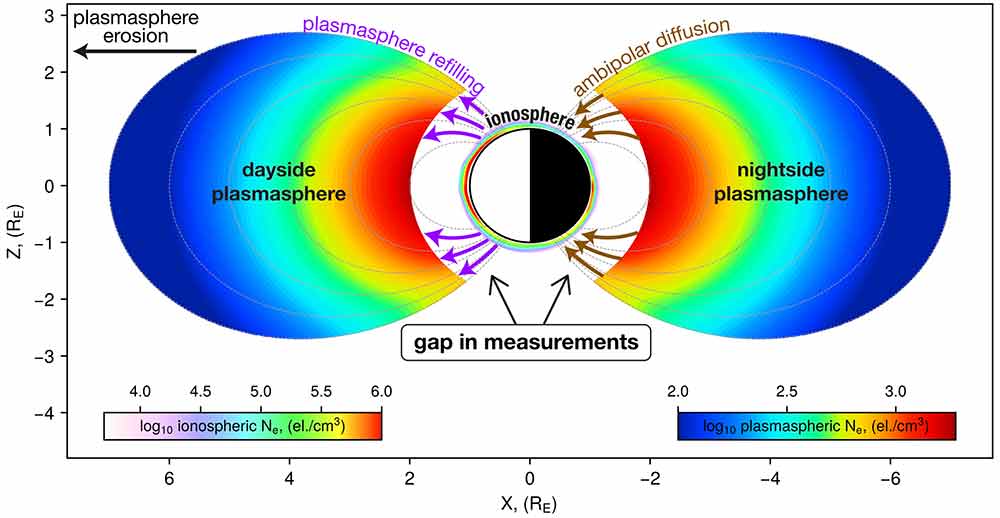
 
Schematic representation of the ionosphere‐plasmasphere system, illustrating the altitude gap in observations between the two regions. The ionospheric
distribution is obtained from the Neural network model of Electron density in the Topside ionosphere model (Smirnov et al., 2023), while plasmaspheric Ne are based on
the Carpenter and Anderson (1992) model with field‐line dependence from Denton et al. (2006).
Schematic representation of the ionosphere‐plasmasphere system, illustrating the altitude gap in observations between the two regions. The ionospheric distribution is obtained from the Neural network model of Electron density in the Topside ionosphere model (Smirnov et al., 2023), while plasmaspheric Ne are based on the Carpenter and Anderson (1992) model with field‐line dependence from Denton et al. (2006). Source: Smirnov, A., Shprits, Y., Lühr, H.,
Kronberg, E. A., Goldstein, J., Miyoshi, Y., et al. (2025). Bridging the gap between the Earth’s ionosphere and plasmasphere. Geophysical Research Letters, 52,
e2025GL119267. https://doi.org/10.1029/2025GL119267